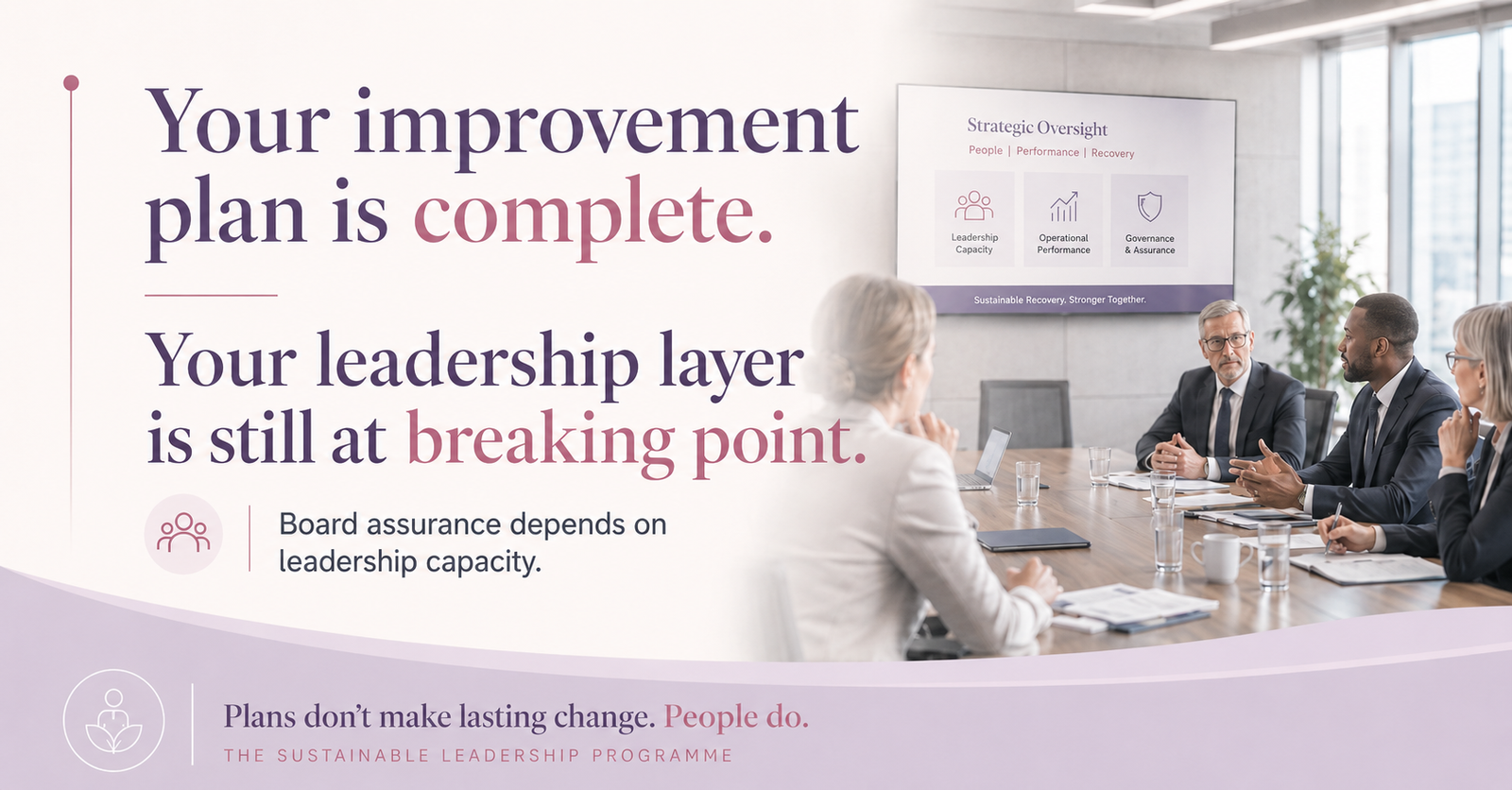
Plans don't make lasting change. People do.
Most NHS Trusts do not fail to improve because no one wrote a plan. They usually have a detailed, monitored plan, complete with owners, deadlines, dashboards, evidence folders, board updates and assurance reports.
The uncomfortable question is different: was the plan designed to evidence progress under scrutiny, or to sustain progress after the scrutiny reduced? That difference matters, and it is one of the clearest ways The Sustainability Gap™ shows up in Trust recovery.
The Sustainability Gap is the gap between completing an improvement plan and having the leadership capacity to sustain the gains.
In CQC recovery work, the gap is often hidden by assurance. The Trust can show movement, the board can see evidence, the inspection narrative can improve, and the risk register can look more controlled as the language of assurance grows stronger. Yet beneath that formal structure, the same senior leaders may still be exhausted, stretched, isolated and carrying more than the system can safely ask of them.
That is the risk. The plan may be improving while the leadership capacity required to sustain it is quietly weakening.
This is not an argument against improvement plans. Improvement plans matter: they create focus, clarify accountability, help boards track progress, and give regulators, executives and teams a shared view of what must change.
The problem is not the existence of the plan. The problem is what many plans are actually built to do.
Some plans are built to satisfy scrutiny. Fewer are built to survive the loss of urgency once the scrutiny has passed, and those are not the same thing.
A plan designed for assurance tends to ask: can we evidence action, can we show progress, can we demonstrate ownership, can we report movement, can we satisfy the next checkpoint? Those are necessary questions, but they are not sufficient ones.
A plan designed for sustainability asks something deeper: who is carrying this improvement, do they have the capacity to keep carrying it, where is leadership fatigue hidden, which senior roles are becoming single points of failure, what happens when the reinspection pressure reduces, and what behaviour must still be happening six months after the rating changes? Those questions are harder to answer, but they are also the ones that determine whether improvement lasts.
What the Evidence Shows
This is where evidence matters. NHS staff wellbeing is not a soft issue sitting outside performance; it is directly connected to patient safety, quality and organisational resilience. The NHS Staff Survey has continued to show high levels of work related stress, burnout, violence, harassment and pressure across the workforce. In 2025 it found that about one in seven staff had experienced violence from patients or the public, while more than a quarter reported harassment, bullying or abuse.
The Medical Defence Union reported in 2025 that 35% of NHS doctors surveyed said they were so tired that their ability to treat patients was impaired, and a further 34% said their ability to practise medicine may have been impaired. The Health Services Safety Investigations Body has warned that staff fatigue contributes directly and indirectly to patient harm.
Those findings matter for Trust recovery. They show that leadership and workforce capacity cannot be separated from safety, and they show why recovery cannot be judged only by whether actions are complete.
A Trust can intensify governance when external scrutiny increases. Meetings become more frequent, reporting becomes tighter, evidence collection accelerates, executive grip becomes more visible, and people work harder as senior leaders absorb more pressure. The organisation appears more focused, and that can produce short-term movement.
It can also create a false sense of safety. Intensity is not the same as sustainability.
A Trust can look more controlled while its leadership layer becomes less resilient. A Director of Nursing can hold a fragile improvement programme together while privately running on empty. A clinical leadership team can keep delivering the evidence while losing the emotional and cognitive capacity required to make the change stick, and a board can receive assurance while missing the depletion underneath it.
That is The Sustainability Gap.
What Happens After the Scrutiny Lifts
The post-reinspection period matters because it exposes what the plan has really built. During inspection pressure, improvement is externally reinforced; after reinspection, that external pressure reduces. Meetings become less urgent, board focus shifts, new priorities arrive, and operational pressure returns to the foreground as vacancies, flow, finance, sickness, complaints, incidents and winter planning all compete for attention.
At that point, the real test begins: not whether the Trust can evidence improvement under pressure, but whether it has built enough leadership capacity to maintain that improvement once pressure normalises.
That is where some plans begin to unravel. Not dramatically. Quietly.
A few behaviours slip. A few routines weaken. A few leaders become harder to reach. A few meetings lose focus. A few actions become compliance tasks rather than cultural habits. A few experienced people leave.
The dashboard may still look acceptable for a while, but the underlying capacity has already started to thin.
This is why NHS recovery cannot be treated purely as a governance exercise. Governance protects patients when it becomes lived behaviour; it does not protect patients when it only becomes better reporting. A stronger committee structure will not compensate for a depleted leadership layer, a sharper dashboard will not restore a burned-out Director of Nursing, and a more detailed action tracker will not create the trust, judgement and energy required to sustain change on the ground.
The human layer carries the plan. When that layer is weakened, the plan becomes fragile.
This is especially important for Trusts rated Requires Improvement or Inadequate, where the pressure to evidence progress is enormous. Boards need grip. Regulators need confidence. Staff need direction. Patients need safer care.
The temptation is to intensify the formal machinery: more reporting, more scrutiny, more actions, more meetings, more assurance. Some of that may be necessary.
Yet if the Trust only increases the weight on the same leadership layer, it may strengthen the appearance of improvement while weakening the people required to sustain it. That is not recovery. That is performance under strain.
The Board Conversation That Changes Everything
Sustainable improvement requires a different board conversation.
Not only: are the actions complete? Also: is the leadership layer strong enough to hold the gain?
Not only: can we show evidence? Also: can our people still think clearly, lead consistently and recover properly?
Not only: are we ready for reinspection? Also: will this still be working a year after reinspection?
Those questions change the nature of improvement. They move the board conversation from assurance to sustainability, and they make the invisible visible.
Senior NHS leaders often hide depletion well. They are skilled at presenting control, briefing a board, carrying risk, and keeping moving when the system needs them. That strength can become dangerous when the organisation starts depending on it without protecting it.
The strongest leaders are often the last to say they are struggling. They hold the plan. They hold the team. They hold the patient safety risk. They hold the emotional weight of the organisation.
Then everyone is surprised when they leave, go off sick, step back, or lose the ability to keep absorbing the pressure. The warning signs were usually there. They just were not on the improvement plan.
This is why leadership sustainability should be treated as part of Trust recovery, not as a wellbeing extra. It belongs in the same conversation as quality, safety, workforce, governance and operational performance.
If the leadership layer collapses, the improvement plan loses its carrier. If the carrier weakens, the gain becomes temporary, and the Trust risks returning to the same pattern under a different action plan.
The question for boards is not whether improvement plans are needed. They are. The question is whether the plan is testing the right thing.
A plan can tell you whether tasks are being completed. It may not tell you whether the people completing them have enough capacity left to sustain the change.
A plan can show evidence of progress. It may not show whether progress is becoming normal practice.
A plan can satisfy scrutiny. It may not protect the Trust from slipping back into distress.
That is the difference between assurance and sustainability.
The NHS does not need fewer improvement plans. It needs improvement plans that take leadership capacity seriously, boards willing to ask where the pressure is being held, executive teams willing to see leadership depletion as a strategic risk, and recovery work that strengthens the people responsible for holding the gain.
The plan was not the problem. The capacity to sustain it was.
Improvement is an event. Sustainability is a capability.
For more information, book a call: contact Anthony directly.
Sources
NHS Staff Survey (2025). Violence, harassment and workforce wellbeing findings.
Medical Defence Union (2025). Fatigue survey of NHS doctors.
Health Services Safety Investigations Body (2025). Fatigue and patient safety report.