The cycle, and how to close it
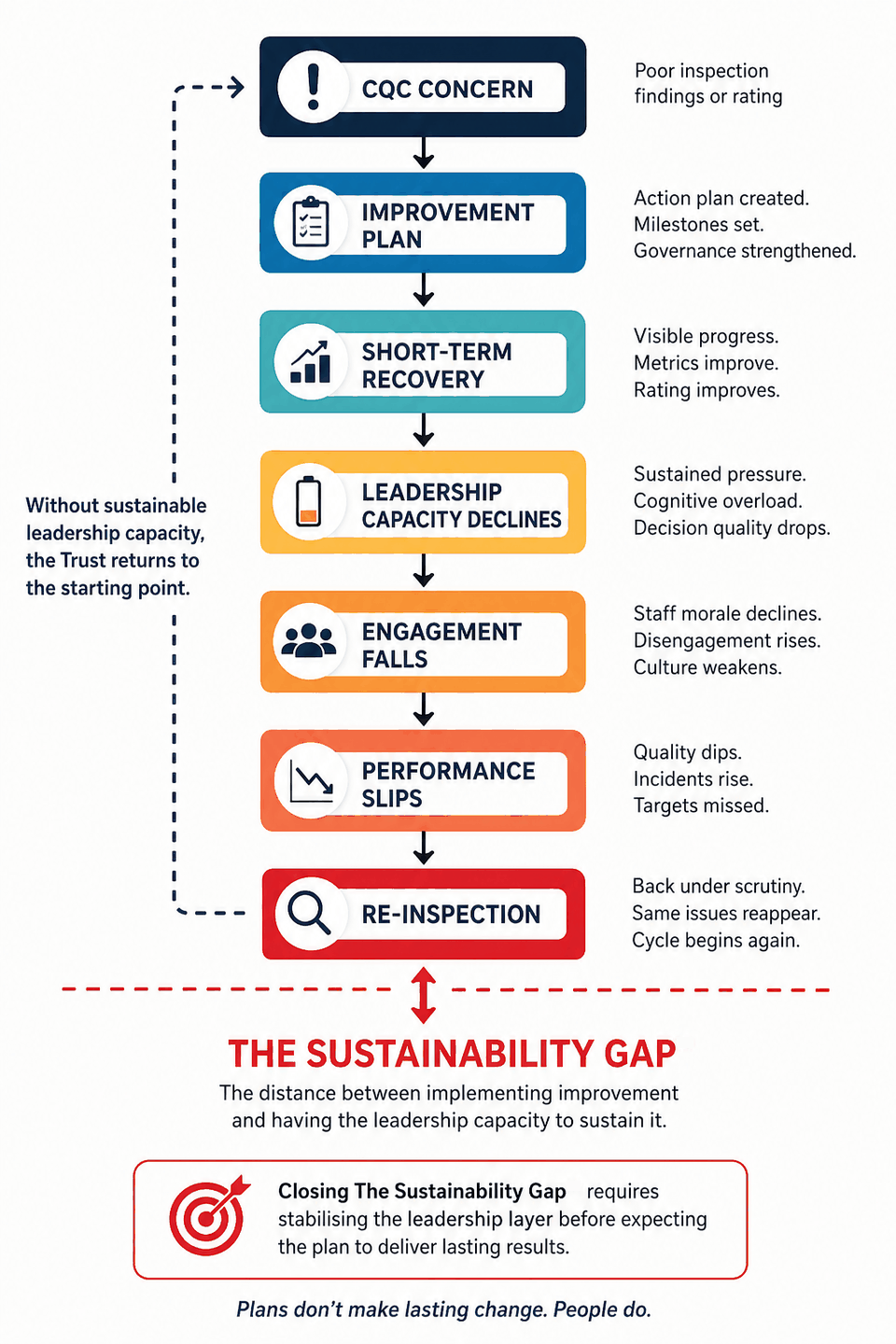
How Trusts get pulled back into re-inspection
For Chief Executives, Chief People Officers, and Accountable Officers
An NIHR-funded evaluation found that Trusts which struggled after special measures had often completed their improvement plans, but had not retained the leaders those plans depended on.
See the three-stage pathwayThe core idea
The Sustainability Gap is the gap between completing an improvement plan and having the leadership capacity to sustain the gains.
Many NHS Trusts can evidence progress under scrutiny. Actions are tracked, dashboards improve, assurance reports strengthen and board updates show movement.
The harder question is whether the leadership layer has enough capacity to keep holding that improvement once external pressure reduces.
This is where recovery often becomes fragile.
A Trust may complete the plan, satisfy scrutiny and still leave the same senior leaders exhausted, stretched and carrying more than the system can safely ask of them.
The plan may be improving while the people required to sustain it are weakening.
That is The Sustainability Gap.
The Sustainable Leadership Programme helps Trusts identify where leadership capacity is under pressure, where key roles are becoming single points of failure, and what support is needed to sustain improvement beyond the inspection period.
Plans don't make lasting change. People do.
The cycle, and how to close it
What you are facing
Your Director of Nursing is carrying a caseload no single person was designed to carry. Your senior clinical leads are leaving meetings and not coming back. Your governance meetings are fuller than ever. Your leadership layer is emptier than it looks on paper.
The standard CQC improvement response places more accountability on the leaders already running on empty. More reporting. More scrutiny. More pressure at precisely the moment your people need stability, not more weight.
CQC moved to continuous Well-Led assessment in 2024. The picture is forming every week, not just at inspection. A Trust that stabilises its senior leadership layer is strengthening its Well-Led score in real time. A Trust that loses another Director of Nursing is weakening it.
Plans don't make lasting change. People do.
Losing a Director of Nursing brings more than a recruitment cost. It means interim cover, disrupted relationships, delayed decisions and the loss of institutional knowledge at exactly the point the Trust most needs continuity. The Sustainable Leadership Programme is not a wellbeing spend. It is a leadership retention investment with a measurable ROI.
£3bn
spent on NHS agency staff in 2023/24, not because the NHS ran out of nurses, but because it ran out of nurses who wanted to stay.
0.57
regression coefficient linking staff engagement to CQC performance across 97 NHS acute Trusts, 2012 to 2016. Peer-reviewed. BMJ published.
Why this matters after CQC scrutiny
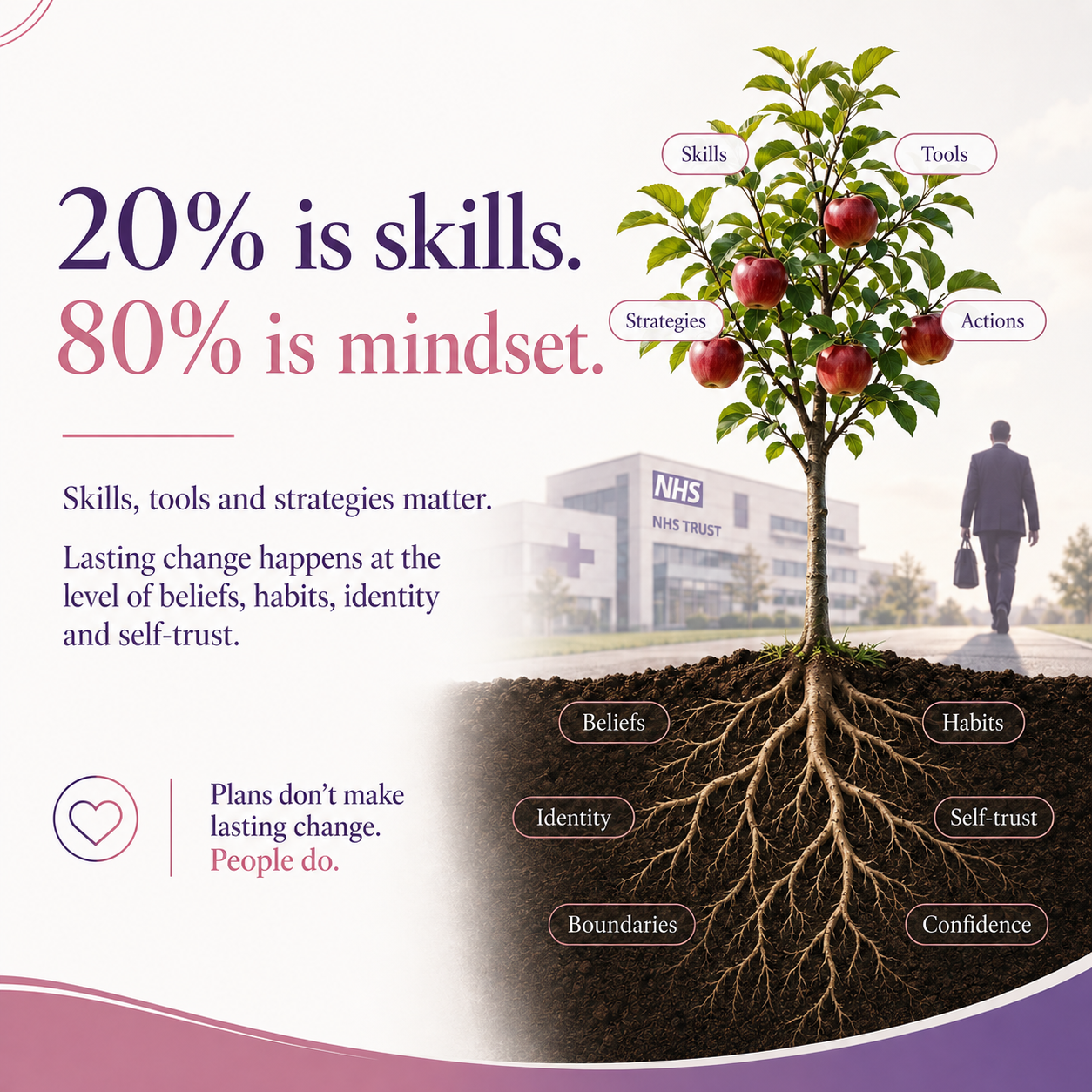
This is not the traditional Pareto principle. Tools, knowledge and technical capability matter, but they account for only part of the result.
Lasting improvement depends on the mindset, belief, identity, trust and shared ownership of the people expected to deliver the plan.
When those foundations are weak, organisations often respond by adding more process, more reporting and more scrutiny. That can strengthen compliance without strengthening commitment.
The plan provides direction. The people create the result.
Roughly 20% of a Trust's recovery depends on the quality of the improvement plan. The other 80% depends on the mindset, belief, identity and shared vision of the people the plan asks to carry it.
Most recovery work concentrates on tools, knowledge and skills. Sustainable recovery also develops the mindset, belief and leadership identity required to use them well.
Read the article: The Sustainability Gap: Why Improvement Plans Fail After CQC Reinspection
Free Board-Level Tool
Most improvement plans measure whether actions are complete. Fewer test whether the leadership layer still has the capacity to sustain the gains.
The Leadership Sustainability Audit is a free Board-level tool designed to help NHS Trusts, OD leads and recovery advisers identify where The Sustainability Gap may be forming.
It helps you assess:
Plans don't make lasting change. People do.
The three-stage pathway
Each stage is a complete engagement in its own right. A Chief Executive or Chief People Officer can begin at Stage 1 without any commitment to what follows. The diagnostic findings determine whether and how to proceed. There is no pressure to move forward until the evidence points clearly in that direction.
Diagnostic: half-day engagement
A structured review of the leadership stability risks most likely to undermine delivery of your Trust's improvement programme.
Before any programme begins, Anthony meets with your executive team to map the real state of your senior leadership layer. Stress load, retention risk, capacity gaps, and the invisible weight your clinical leads are carrying that does not appear on any dashboard.
Includes executive interviews, leadership risk assessment, and a written report identifying the three highest-priority threats to leadership sustainability and organisational recovery. The report is the basis for any board conversation about what needs to happen next.
Half-day session with executive team. Written report delivered within five working days.
Clear picture of leadership layer risk. Evidence-based recommendations. Board-ready summary.
Six-month structured engagement
Designed for Trusts facing significant improvement pressure, organisational change, or leadership retention challenges.
Working directly with your Director of Nursing and two to three senior clinical leads, Anthony delivers one-to-one coaching alongside a monthly group session for the wider leadership tier. The programme is focused on protecting the leaders responsible for delivering recovery, strengthening leadership resilience, improving sustainability, and reducing the risk of leadership disruption during critical periods.
By the end of six months, your leadership layer is retained, regulated, and producing the kind of engagement scores that show up in your Well-Led data.
Plans don't make lasting change. People do.
One-to-one coaching for named senior leaders. Monthly group session for the wider tier. Six-month duration.
Retained leadership layer. Improved engagement metrics. Documented Well-Led evidence. Reduced agency dependency.
Ongoing strategic support
Ongoing strategic support throughout the continuous assessment cycle.
Provides regular executive coaching, leadership sustainability reviews, early identification of leadership risk factors, and direct access to an experienced leadership stability partner. For Trusts that want to maintain momentum beyond the six-month programme, the retainer keeps Anthony embedded as your leadership stability partner across the full CQC continuous assessment cycle.
Less than the cost of a single interim leadership appointment. Potentially the difference between retaining and losing the leader your improvement plan depends on.
Monthly one-to-one sessions. Quarterly group workshops. Direct CPO contact. Three-month minimum.
Sustained leadership stability. Continuous Well-Led evidence. Long-term retention of senior clinical leaders.
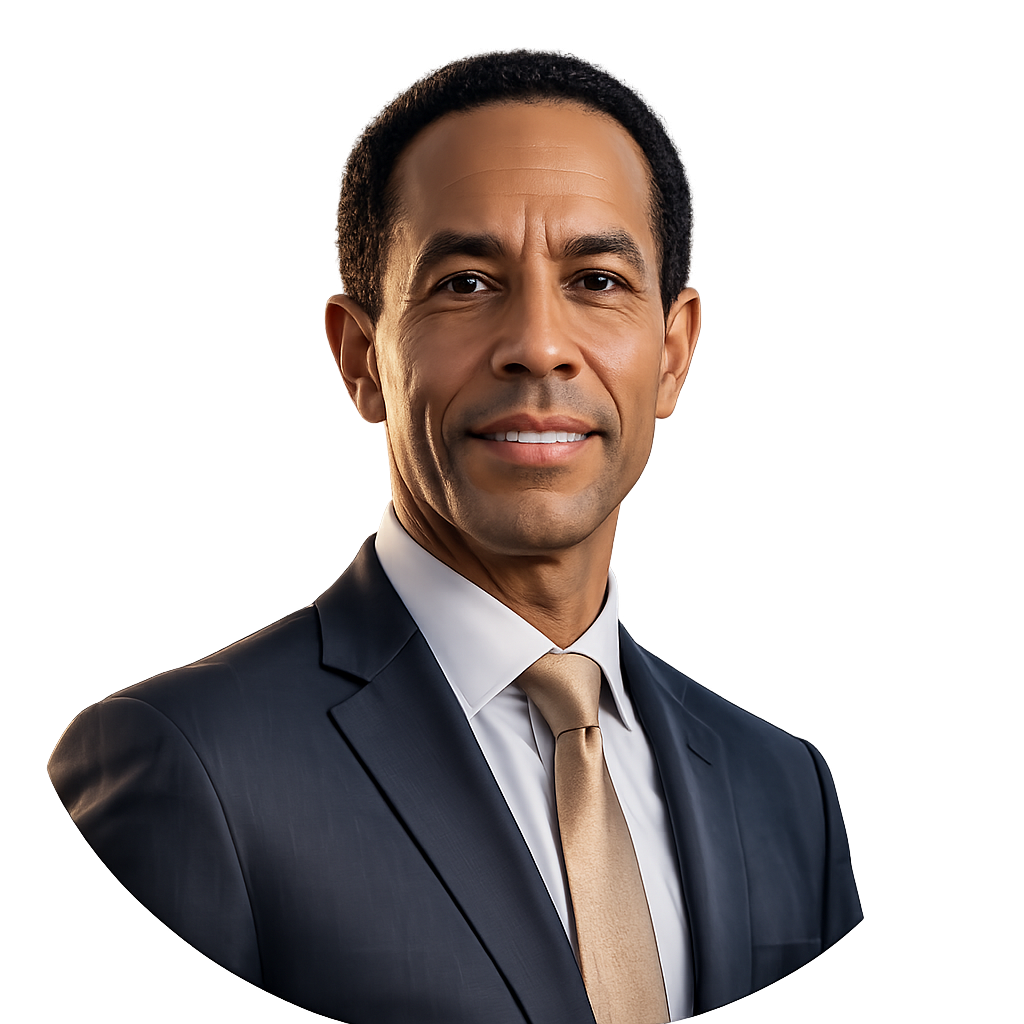
About Anthony Berry
Anthony Berry is a Performance and Sustainability Coach and founder of The Sustainable Leadership Programme. He works with senior NHS leaders in clinical and nursing leadership roles to address the structural causes of chronic stress and burnout.
His background spans coaching, change management, neuro-linguistic programming, and equality and diversity leadership. He brings both the evidence base and the human understanding to work that most wellbeing programmes never reach.
His approach does not begin by asking leaders to focus only on what is wrong or simply cope better with pressure. Using Appreciative Inquiry, he helps them identify the strengths, successful patterns and personal qualities that already enable them to lead well, then builds on these to create sustainable change. The tools are practical, the sessions are structured, and progress is measured against outcomes that matter to the individual leader and the organisation.
Plans don't make lasting change. People do.
What leaders are saying
Perspectives from healthcare and transformation leaders reinforce a consistent message: improvement plans matter, but they cannot replace leadership, culture and whole-system ownership.
"Improvement is an event. Sustainability is a capability. That line deserves to sit on every board agenda."
Elberra Consulting International Ltd
"Improvement is like treating a patient… it's a whole system or nothing."
Karl Bates LSSBB PMI (DASM)
Digital Transformation Specialist in Healthcare
"IT needs to be clinically led and IT enabled."
Jenny Muir, Group CNIO at GESH
These perspectives reflect the central principle behind The Sustainability Gap: completing an improvement plan is not the same as building the leadership capacity, culture and ownership needed to sustain the gains.
A plan can provide structure. Governance can provide assurance. Technology can enable change, but lasting improvement depends on people having the capacity, authority and support to hold that change when the external pressure reduces.
Plans don't make lasting change. People do.
A complimentary 30-minute conversation to identify where your Sustainability Gap may be sitting. No pitch. No obligation. Just a direct conversation about what your Trust actually needs and whether Stage 1 is the right next step.
Book your free 30-minute callNo commitment required. The call is a conversation, not a sales meeting.
Get in touch directly
Anthony responds personally to Trust enquiries.