
You finished your shift hours ago. You are home. The ward is behind you. And yet your mind is still there, replaying a difficult conversation with a consultant, running through tomorrow's staffing gap, wondering if you handled that family member the right way at 4pm.
It is midnight. You should be asleep.
If this is familiar, I want you to know something before we go any further: there is nothing wrong with you. You are not weak. You are not failing. And this is not simply a matter of needing to relax more.
What is happening in your body has a name, a mechanism, and crucially, a solution grounded in neuroscience.
Why You Cannot Switch Off: The Science
Your body has a built-in stress response system, the autonomic nervous system, which constantly scans your environment for threat. When it detects danger, it activates your sympathetic nervous system: heart rate rises, cortisol floods the body, your mind sharpens to a point.
This is the fight or flight response. It evolved to help human beings survive predators. It is extraordinarily effective at keeping you alive.
The problem is that your brain cannot easily distinguish between a lion and a full inbox, a staffing crisis, a governance meeting, and seventeen unread messages from your deputy. They all register as threat. And when you spend eight to twelve hours in a high-pressure clinical environment, your nervous system spends most of that time in a state of activation.
Simply going home does not turn it off. The nervous system does not reset automatically. Without a deliberate transition, your body continues to operate as if the threat is still present.
This is why you wake at 3am with your mind already racing. Your nervous system never received the signal that you were safe.
What the Research Tells Us
This is not theory. It is biology, and the evidence is substantial.
42.3% of NHS staff reported work-related stress in the 2025 Staff Survey, with nearly one in three describing themselves as burnt out. Positive employer action on wellbeing fell to its lowest ever recorded level.
Research published in the journal Frontiers in Public Health found a direct association between sleeping fewer than seven hours and significantly higher burnout risk in healthcare professionals. A separate study found that physicians sleeping five or fewer hours were twice as likely to be named in a malpractice suit.
This is not about character. It is about biology operating under sustained pressure.
The Brain Can Change. That Changes Everything.
Here is the most important thing neuroscience has given us in the last two decades: the concept of neuroplasticity.
Your brain is not fixed. It is not set at birth or hardened by experience. The neural pathways that drive your stress response, the patterns that keep you on high alert long after you have left the ward, were formed through repeated experience. And through repeated practice, they can be reformed.
A 2025 review published in the National Center for Biotechnology Information confirmed that both physical and emotional interventions can meaningfully modulate neuroplasticity. In plain terms: what you practise, your brain becomes better at. Including calm.
Polyvagal Theory, developed by Dr Stephen Porges, offers an even more precise framework. It proposes that the nervous system has three states: ventral vagal (safe, calm, connected), sympathetic (activated, alert, stressed), and dorsal vagal (shutdown, exhausted, disconnected). Most burnt-out senior nurses are oscillating between the second and third. The goal is not to eliminate stress responses. It is to build the capacity to return to the first state, reliably and quickly.
What Seven Minutes Can Do
A peer-reviewed study published in the National Library of Medicine examined the effects of seven-minute breathing and meditation practices on perceived stress. The results showed significant reductions in stress and improvements in mood, not from an hour-long yoga class or a two-week retreat, but from a consistent seven-minute practice.
This matters for you specifically because you do not have spare hours. You have gaps. You have the commute home, the five minutes before a meeting, the moment between closing the door and starting dinner.
The nervous system does not need a long time. It needs a consistent signal. And that signal can be taught, practised, and over time automated, so that your body begins to regulate itself rather than waiting for exhaustion to do the job.
What This Means for How You Lead
The research is clear on one more thing: burnout does not stay contained to the individual.
When senior nurses are operating in a state of chronic sympathetic activation, always alert, never fully recovered, the quality of clinical decision-making is affected. Communication changes. Patience erodes. The emotional availability that makes great leaders extraordinary begins to narrow.
A 2024 systematic review found that burnout negatively affects clinical decision-making, communication, and overall quality of care. This is not a personal failure. It is a physiological one. And it is reversible.
This Is Not About Coping Harder
Most wellbeing programmes offer you coping strategies. Breathing exercises to get through the day. Time management tips. Mindfulness apps.
These are not worthless. But they treat symptoms. They ask you to manage a stress response that has not been addressed at its root.
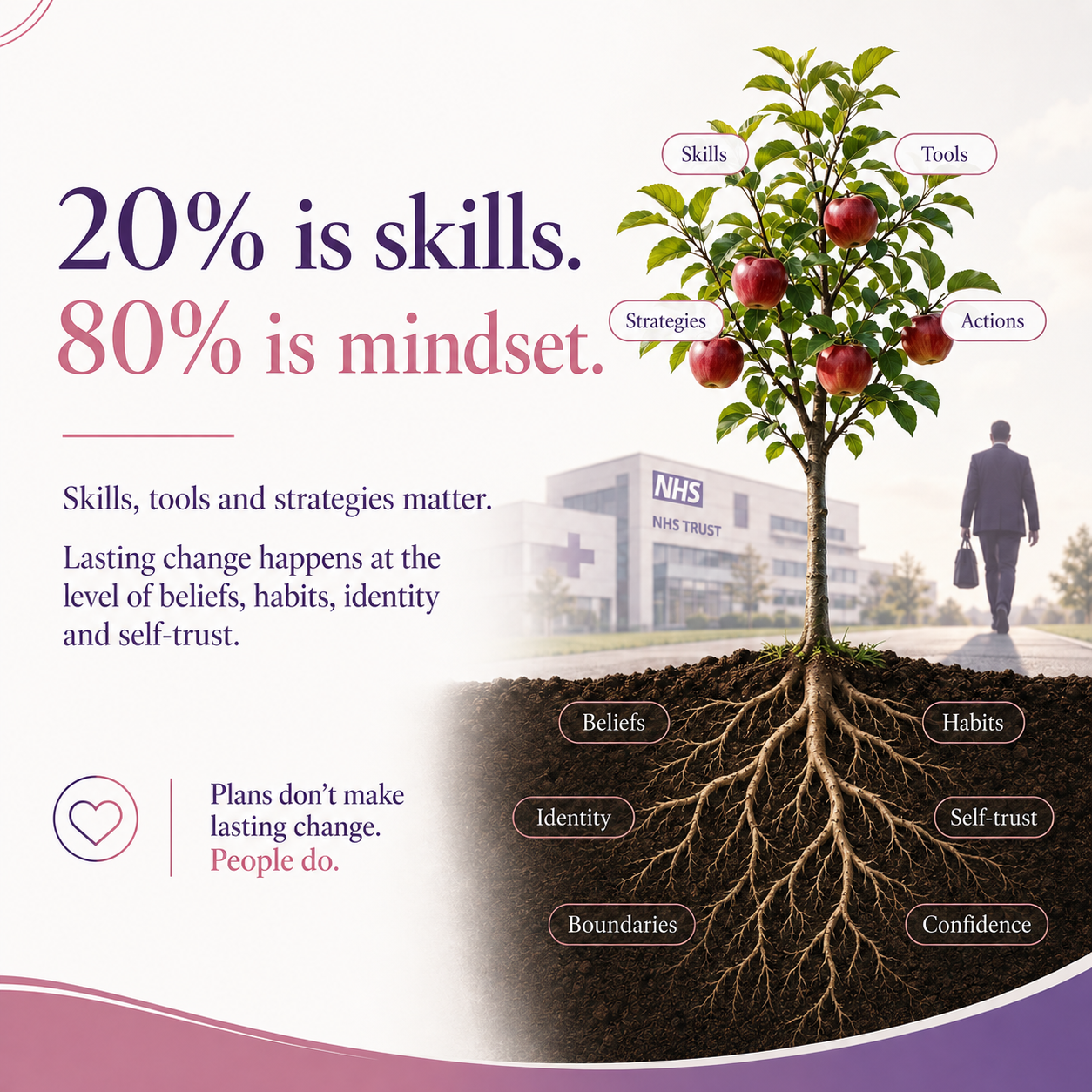
The Sustainable Leadership Programme is built on the science above, specifically on the principles of neuroplasticity, nervous system regulation, and the evidence base for rapid, measurable stress reduction. In 12 sessions of 60 minutes each, delivered online, we work through a structured four-pillar system that resets your stress response, reclaims your personal boundaries, restores your sleep, and builds the habits that sustain calm even when everything hits at once.
The results are measurable: stress reduced by 50%, two personal hours reclaimed per week, consistent sleep, and a calmer, more grounded version of the leader you already are.

References
NHS Staff Survey 2025, NHS Employers
Frontiers in Public Health, Sleep Duration and Burnout in Healthcare Professionals (2023)
PMC, Effects of 7-Minute Breathing and Meditation Practices on Stress Reduction (2024)
PMC, Physical and Emotional Interventions in Modulating Neuroplasticity (2025)
PMC, Polyvagal Theory: Current Status and Clinical Applications (2025)
PMC, Systematic Review: Burnout and Quality of Care (2024)